
Porcelain Tile Installation
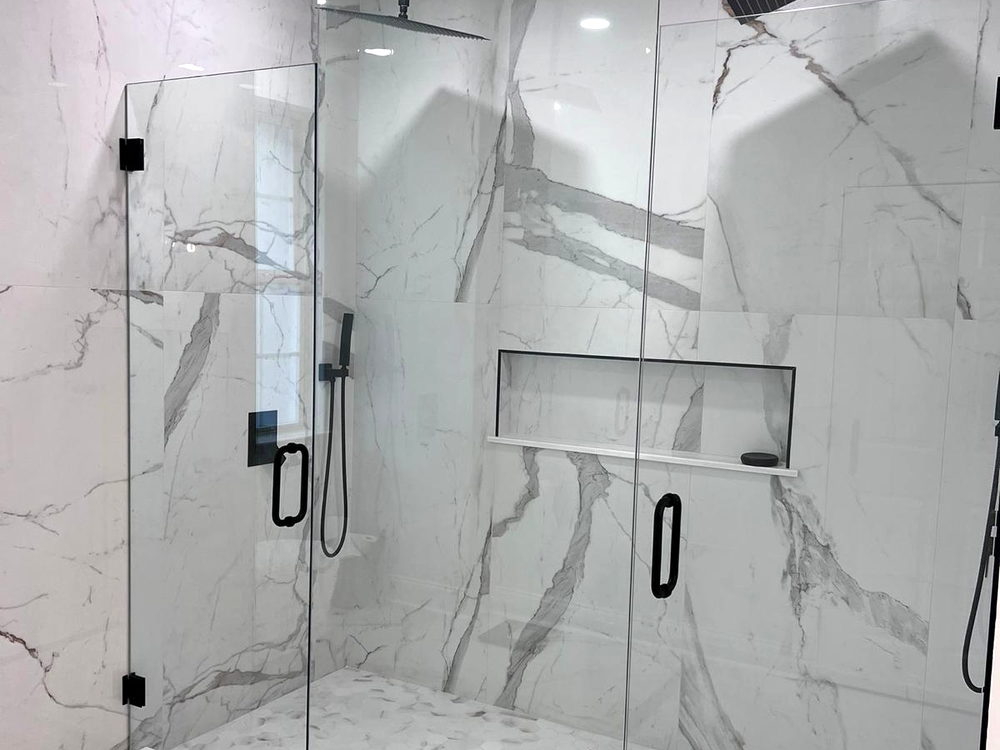
Large-format porcelain set with lippage control and tight, even joints.
How we approach porcelain
Porcelain has taken over Louisiana floors for good reasons. It absorbs almost no water, it handles the swing between a humid slab and an air-conditioned room without complaint, and the printing on current products reads convincingly as wood, concrete or marble. What it does not forgive is careless installation. The same density that makes porcelain durable also makes it unforgiving of an uneven bed.
The dominant format now is large: 12 by 24, 24 by 48, and slabs beyond that. A long tile amplifies every flaw underneath it, because the tile itself will not bend to follow the floor. That is why our porcelain jobs in Kenner and Metairie begin with substrate correction and a leveling system rather than with mortar. Clips and wedges hold adjacent edges in plane while the mortar sets, and they come out the next day with the joints still true.
Coverage is the second half of the job. Large tiles need mortar combed in one direction and the back of the tile buttered so the bed collapses into full contact instead of leaving voids. A void under a corner is where a chip starts, usually a year later when a dropped pan finds it. We work to full coverage on the field and check by lifting a tile early in each room.
Layout on porcelain deserves more attention than most homeowners expect. Rectified tile has sawn edges that allow very tight joints, which looks superb and leaves nowhere to hide misalignment. Wood-look planks need a stagger pattern with offsets kept under a third of the plank length, or the floor develops the pointed-corner lippage that people describe as a floor that feels wrong to walk on barefoot.
For showers, backsplashes and walls, porcelain brings a different set of decisions: bullnose versus mitered edges, where the pattern breaks at a niche, and how a large tile meets a drain. We plan those cuts on paper before the saw comes out, because a 24 by 48 tile is not something you improvise with.
Six things that decide the result
Lippage kept under control
Leveling clips hold adjacent edges flush while mortar cures, which is the only reliable way to keep long tiles in plane.
Full mortar coverage
Combed in one direction plus back-buttering on large formats, verified by pulling a tile early in each room.
Rectified-edge layouts
Tight joints laid out from center lines so the tightness reads as precision instead of exposing drift.
Stagger patterns done right
Wood-look planks offset within manufacturer limits to avoid corner lippage and a repeating pattern.
Cuts planned before cutting
Niches, drains, outlets and corners are mapped on the layout so expensive tile is not wasted.
Edges finished deliberately
Bullnose, metal profile or mitered corner chosen with you, then executed consistently across the job.
What is written into your quote
Substrate work
- Flatness check against large-format tolerance
- Self-leveler or patch where required
- Uncoupling membrane over questionable slabs
- Moisture testing before setting
Setting system
- Large-format mortar rated for the tile size
- Correct trowel notch per format
- Back-buttering on tiles over 15 inches
- Leveling clips and wedges throughout
Layout and cutting
- Center lines and dry-laid first courses
- Wet-saw cuts with a porcelain blade
- Mitered or profiled outside corners
- Cut placement kept out of sightlines
Grout and seal
- Grout matched to joint width
- Haze removal same day
- Silicone at changes of plane
- Sealing for stone-look grout where specified
From the first call to the walkthrough
Tile review
We look at the actual product: format, rectified or not, warpage and recommended joint.
Substrate plan
Flatness results decide whether the floor needs leveling, membrane or both.
Layout approval
Center lines set, first rows dry-laid, cut placement confirmed with you.
Setting with clips
Full coverage mortar, leveling system in place, joints held true while curing.
Grout and detail
Grout, clean, silicone the movement joints, then walk the floor together.
Why large-format porcelain punishes shortcuts
Porcelain is harder than most tile, which means it cuts slower, chips at the edge if the blade is dull, and cannot be scored and snapped like ceramic. A dry-cut angle grinder leaves a rough edge that shows anywhere it is not covered by a profile. Professional installs use a wet saw with the correct blade, and they use enough blades to keep the cuts clean through the last box.
The bigger risk is invisible. A tile with sixty percent mortar coverage looks identical to one with full coverage on the day it is set, and the difference only appears when the hollow spot cracks. By then the fix means removing surrounding tile, chiseling the old bed and matching a dye lot that has moved on. Getting coverage right the first time costs a fraction of that.
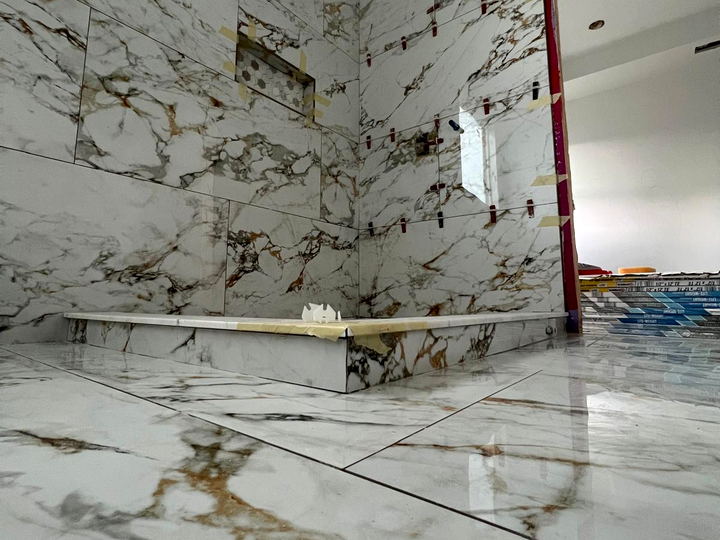
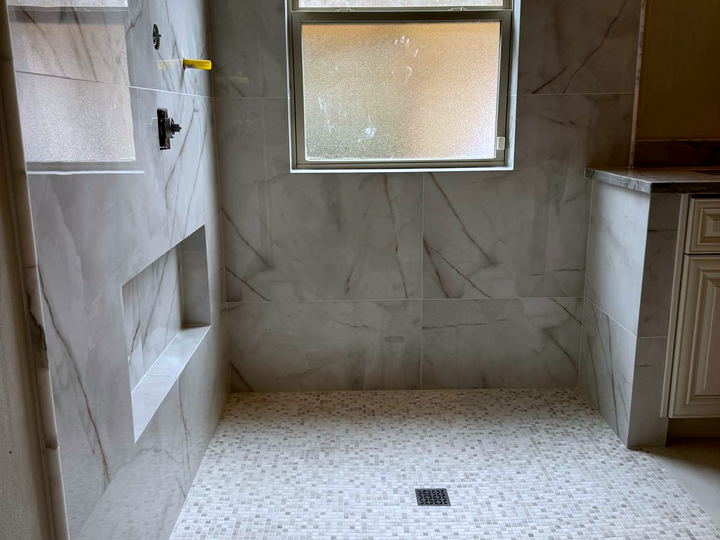
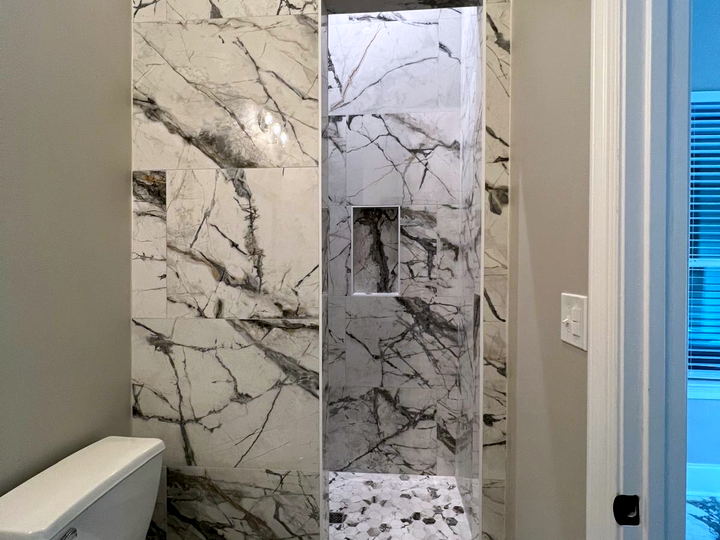
Porcelain work in the area
Porcelain: the seven we hear most
For floors, usually yes. Porcelain absorbs under half a percent of water and holds up to point loads better, which matters in kitchens and entries. Ceramic still makes sense on walls and in low-traffic areas where its lower cost and easier cutting are real advantages.
Rectified tile is cut to exact size after firing, so the edges are perfectly straight. It allows joints as tight as a sixteenth of an inch. Non-rectified tile has slightly rounded, varying edges and needs a wider joint to absorb the difference. Rectified looks sharper but demands a flatter substrate.
Yes, with the right support. Wall installs need mortar rated for vertical hold, mechanical support during curing on the largest formats, and a substrate that is plumb. We check the wall before quoting because framing that is out of plumb is the usual obstacle.
They are consumable. Clips break off when removed and are not reused, so a large floor uses hundreds of them. They are the difference between a floor that reads flat and one where you feel every edge, so we include them rather than treat them as optional.
Plan on about ten percent for a straight layout and fifteen for diagonal or herringbone patterns, plus a box kept for future repairs. Dye lots change, so the leftover box is the only realistic way to match a repair five years from now.
It depends on the finish, not the material. Look for the DCOF rating on the spec sheet: 0.42 or higher is the accepted threshold for level interior floors expected to get wet. Polished porcelain looks striking and is a poor choice for a bathroom floor or an entry.
We install slab-format porcelain on walls and shower surrounds. Countertops in slab porcelain require fabrication equipment we coordinate with a stone shop, and we will tell you upfront when a job needs that partner rather than taking it on halfway.
Usually booked alongside this
Where we do this work
Porcelain jobs run out of Kenner and across Metairie, Harahan, River Ridge, New Orleans, Elmwood, Westwego, Gretna, Marrero and Destrehan. See the full service area map.
- Kenner, LA
- Metairie, LA
- Harahan, LA
- River Ridge, LA
- New Orleans, LA
- Elmwood, LA
- Westwego, LA
- Gretna, LA
- Marrero, LA
- Destrehan, LA
Get a fixed price for your porcelain job
Free on-site visit. Bring the tile you like and we will confirm the format, the DCOF and the substrate work together.
Free estimates. No obligation.
