
Vinyl & Laminate Flooring
Luxury vinyl plank and laminate over a subfloor that has been made right.
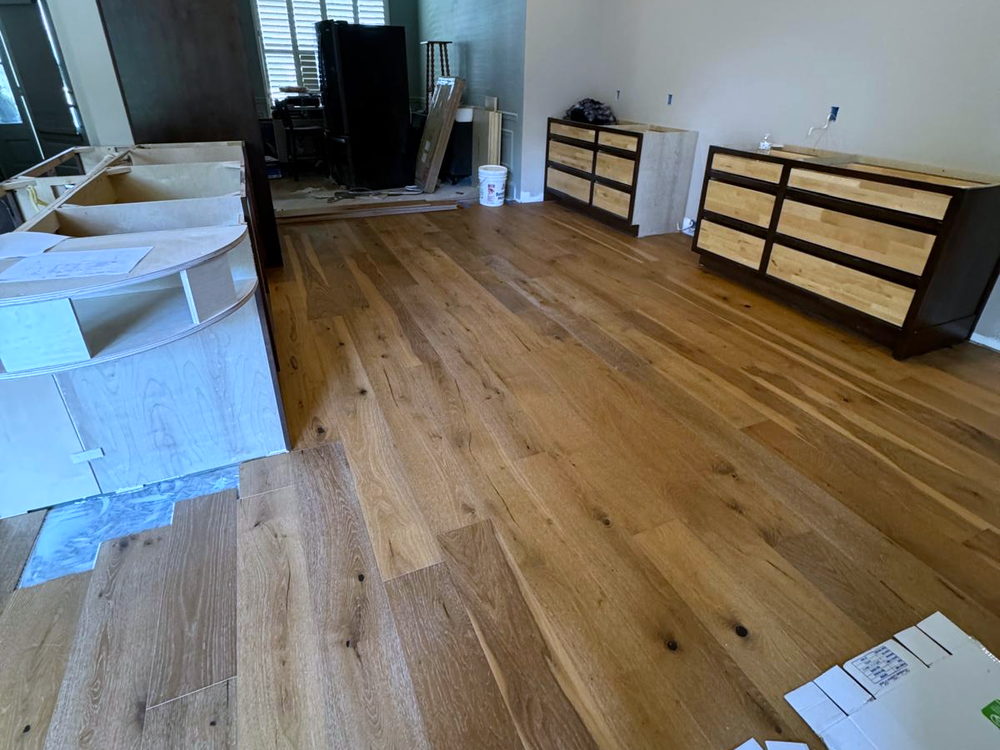
How we approach vinyl & laminate
Luxury vinyl plank has become the default floor for Gulf Coast homes, and the reason is water. A rigid-core vinyl floor does not swell when a dishwasher hose fails or when a storm pushes water under a door, and it can be dried and kept rather than torn out. Laminate is harder and often looks sharper underfoot, but its core is wood fiber, and standing water in a seam is still the failure that ends a laminate floor.
Both products are floating floors, and floating floors succeed or fail on two things: the flatness of what is under them and the expansion gap around them. A floating plank locks to its neighbors and moves as one large panel. If it is pinched at a wall, under a door casing or against a cabinet toe kick, it has nowhere to go and it peaks at the seams. We leave the gap the manufacturer specifies, hide it behind base or quarter round, and undercut door casings so the plank slides beneath them instead of butting into them.
Substrate prep is the part people skip. Vinyl is thin and flexible enough to read every ridge in an old adhesive residue and every dip in a slab. On a slab-on-grade home in Kenner or Westwego we grind ridges flat, patch depressions and check moisture before anything goes down. On a plank subfloor we screw down loose areas, replace soft sheets and flatten the seams.
Layout still matters even though there is no grout. We plan plank direction along the longest sightline or toward the main light source, stagger end joints so the pattern never repeats close together, and make sure the last row is not a two-inch sliver. Boxes get mixed as we work so the printed pattern variation spreads across the room rather than clustering.
The finish is in the transitions. Doorways between rooms, changes to tile, stair nosings and the meeting with an exterior threshold all get a specified profile in a color that matches the floor. Those pieces are what separates an installed floor from a floor that just got laid down.
Six things that decide the result
Water-appropriate product advice
We tell you where rigid-core vinyl is the right call and where laminate will look better and hold up fine.
Substrate flattened first
Grinding, patching and moisture testing so the plank does not telegraph what is underneath.
Expansion gaps to spec
Perimeter gaps kept at the manufacturer's dimension and hidden behind trim, not caulked shut.
Casings undercut
Door jambs and casings cut so the floor runs under them, which looks finished and lets the floor move.
Staggered, mixed layout
Boxes blended and end joints offset so the printed pattern never repeats in an obvious rhythm.
Matching transitions
T-molds, reducers, stair nosings and thresholds specified in the floor's color and fastened properly.
What is written into your quote
Removal and prep
- Old flooring, tack strip and staples removed
- Adhesive residue ground flat
- Slab moisture reading recorded
- Squeaks and loose subfloor fastened
Underlayment
- Pad selected for the product and the slab
- Vapor retarder over concrete where required
- Seams taped continuously
- Sound-reduction options on upstairs rooms
Installation
- Plank direction planned to the sightline
- End joints staggered beyond minimum offset
- Boxes mixed for pattern variation
- Casings undercut instead of scribed
Trim and transitions
- Perimeter gap maintained and covered
- T-molds and reducers color matched
- Stair nosings fastened, not glued only
- Baseboard reinstalled or replaced
From the first call to the walkthrough
Measure and select
We measure, look at your slab or subfloor and help you choose between vinyl and laminate.
Written scope
Product, prep, transitions, timeline and exclusions in one document.
Prep
Old floor out, surface flattened and cleaned, moisture verified.
Install
Underlayment, planks, undercut casings and transitions.
Finish
Trim set, floor cleaned, care instructions handed over.
Why floating floors fail when installed casually
Almost every floating-floor complaint traces back to one of three causes: no expansion gap, an unflat substrate, or a locking system damaged during installation. All three are installation decisions rather than product defects, and all three void most manufacturer warranties. A peaked seam in the middle of a room is not a bad plank. It is a plank that was pinched at a wall thirty feet away.
Installers who do this daily also know the small things: that a tapping block protects the locking edge while a hammer on a bare plank destroys it, that the last row often needs to be cut lengthwise and pulled in with a bar, and that a doorway needs the floor to run through rather than break at the threshold unless the run exceeds the manufacturer's maximum length. Those details cost nothing and decide the outcome.
Vinyl & Laminate work in the area




Vinyl & Laminate: the seven we hear most
The plank itself is, for rigid-core products. Water can still get through the seams and sit on the subfloor beneath, so a standing leak is not harmless. The advantage is that the floor survives an event that would destroy laminate or hardwood: you dry it out and keep it rather than replacing it.
Often yes, if the tile is well bonded and the grout joints are not deep or wide. Wide joints telegraph through thinner planks, so those get skim-filled first. We also check the height at doors, appliances and thresholds before recommending it.
Rigid-core vinyl with a thicker wear layer, generally 20 mil or better for active households. Laminate resists scratching very well on the surface but shows water damage from accidents at the seams. Vinyl trades a little scratch resistance for much better water behavior.
Not a second pad, no. Stacking pads makes the floor feel spongy and can void the warranty. Over concrete you may still need a separate vapor retarder even with attached pad, which depends on the product and the slab's moisture reading.
Whatever the manufacturer specifies, typically a quarter inch, more on long runs. It is covered by baseboard or quarter round, never filled with caulk. Caulking the perimeter turns a floating floor into a glued one and causes peaking.
Yes, and it is one of the best uses for it. We recommend silicone at the perimeter in wet rooms instead of a rigid seal, and running the plank under the toilet flange rather than cutting around it where the layout allows.
Immediately for floating floors, since there is no adhesive cure. Use felt pads under furniture legs and wide casters on rolling chairs. For glue-down vinyl, wait the adhesive's cure window, usually 24 to 48 hours, before heavy items.
Usually booked alongside this
Flooring & Tile
Hardwood-look, tile and stone floors installed flat, level and square. See this servicePorcelain
Large-format porcelain set with lippage control and tight, even joints. See this serviceResidential & Commercial
One crew for occupied homes and for spaces that have to open on schedule. See this serviceWhere we do this work
Vinyl & Laminate jobs run out of Kenner and across Metairie, Harahan, River Ridge, New Orleans, Elmwood, Westwego, Gretna, Marrero and Destrehan. See the full service area map.
- Kenner, LA
- Metairie, LA
- Harahan, LA
- River Ridge, LA
- New Orleans, LA
- Elmwood, LA
- Westwego, LA
- Gretna, LA
- Marrero, LA
- Destrehan, LA
Get a fixed price for your vinyl & laminate job
Free on-site visit. Moisture reading, subfloor prep listed line by line, and a fixed price per room.
Free estimates. No obligation.
